

In the world of jewelry and investment, gold remains a symbol of value and security throughout the ages. However, the true source of confidence in any piece of gold lies not only in its luster but also in the small markings engraved upon it. These markings are not mere aesthetic details, but rather precise messages conveying essential information about purity, karat, country of origin, and even the entity responsible for inspection and quality control.
When discussing the types of hallmarks and stamps on gold , we are addressing a fundamental element in protecting your money and ensuring the security of your investment, especially given the diversity of markets and the varying standards from one country to another. Understanding these hallmarks empowers you to distinguish between genuine and counterfeit gold, making you more informed when purchasing, whether for adornment or investment.
In this article, we review in detail the types of seals and stamps on gold , the meanings of each seal, and how to verify its authenticity so that you can make an informed and safe purchasing decision with complete confidence.
What are the seals and stamps on gold?
Seals and hallmarks are official marks that are precisely engraved or etched onto pieces of gold, whether they are jewelry such as rings and bracelets or investment bullion, and are intended to legally and reliably document the most important characteristics of the piece.
A hallmark is often a mark from a government agency or authorized regulatory body, confirming that the piece has undergone rigorous standard testing and that its purity meets the stated specifications. A stamp, on the other hand, is usually the manufacturer's or factory's logo and serves as an identifier indicating the piece's origin and quality. The presence of both hallmarks enhances confidence and contributes to determining the market value of gold based on its purity and karat.
These hallmarks are often small and engraved in inconspicuous locations to maintain aesthetic appeal, such as the inside of rings or near the clasps of chains and bracelets, and may require a magnifying glass to read clearly. According to international standards, hallmarks must be clear, precise, and indelible to be considered official and reliable proof of the gold's authenticity and quality.
Types of seals and stamps on gold
Gold hallmarks are divided into main categories according to their purpose, and each type carries a specific meaning that helps accurately determine the value and authenticity of the piece. Here are the most prominent types:
1) Standard seal
It is one of the most important hallmarks, as it indicates the percentage of pure gold in the piece, measured out of 24 parts.
- 24K means pure gold with a purity of approximately 99.9%, and is often also written as 999 .
- 18K means that the piece contains 75% gold and 25% other metals to increase hardness, and it is symbolized by 750 .
- 21K is usually written as 875 and means 87.5% gold.
This seal is the basis for determining the price, because the market value is directly related to the purity percentage.
2) Country of origin stamp
It indicates the country where the part was manufactured or inspected, such as:
- SA for the Kingdom of Saudi Arabia.
- IT for Italy.
- UK for the United Kingdom.
The presence of this seal indicates compliance with the regulatory standards adopted in the aforementioned country, and enhances confidence, especially in global markets.
3) Manufacturer's or factory seal
It is a logo, symbol, or acronym that indicates the identity of the manufacturer.
This seal helps in tracing the origin of the piece and holding the producer accountable for quality, and it is also important for luxury or branded pieces.
4) Conformity and Quality Stamps
These are official marks that confirm that the item has passed purity tests from an accredited regulatory body.
- In France, the eagle symbol sometimes appears to indicate the caliber.
- In the United Kingdom, the lion's head symbol is used to denote 18-karat gold.
These symbols vary from country to country, but they serve the same purpose: to guarantee purity and quality according to official standards.
5) Additional stamps such as GF or HGP
These markings do not indicate pure gold, but rather that the piece is gold-plated :
- GF means that there is a layer of gold bonded to a base metal.
- HGP stands for relatively thick gold plating.
The presence of these hallmarks distinguishes between pure gold and plated gold, which is very important to avoid paying the price of pure gold for a piece that is only plated.
How to check and distinguish genuine seals and stamps from forged ones
Knowing the types of seals and stamps on gold is not enough on its own; you must also know how to verify them practically to avoid falling into the trap of fraud or buying a piece at a price higher than its real value.
The first step is a careful visual inspection using a magnifying glass. A genuine hallmark will be clear, with sharp edges and consistent engraving, while a forged hallmark will often appear dull, irregular, or engraved to varying depths. The hallmark's placement will also be logical and professional, such as inside a ring or near a chain clasp.
Effective verification methods:
1. Chemical acid test
A special acid is used to test gold; a small drop is placed on an inconspicuous area of the piece. High-carat gold does not react quickly, while other metals may discolor or corrode. It is best to have this test performed by a professional to avoid damaging the piece.
2. XRF device or digital microscope
Major laboratories and gold shops rely on X-ray fluorescence (XRF) analyzers, which measure the chemical composition with high precision without damaging the piece. This method is among the safest and most reliable.
3. Magnet test
Pure gold is non-magnetic. If the piece is strongly attracted to a magnet, this indicates that it contains a significant amount of other metals. However, low-carat gold may contain a small percentage of other metals that would cause it to be only slightly attracted, so this test alone is not conclusive.
4. Comparing the stamps to international standards
Check out internationally recognized symbols, such as:
- 916, which refers to 22 caliber in the United Kingdom.
- 585 , which indicates 14 karat according to European standards.
Tips for verifying the hallmark on gold
- Don't rely solely on color or shine; some plated pieces look as dazzling as pure gold.
- Avoid purchasing from unreliable sources or without an official invoice.
- If you have doubts about the authenticity of a piece, consult a certified jeweler or an official body such as the Saudi Standards, Metrology and Quality Organization.
The importance of hallmarking gold
The hallmark is a crucial element in evaluating any piece of gold. It's not merely an engraved mark, but an official certificate reflecting the purity and quality of the metal. Understanding the different types of hallmarks and stamps on gold reveals the true value of this mark, as it indicates the karat and the percentage of pure gold, confirming the piece's authenticity and legitimacy according to local and international standards. This enhances buyer confidence and increases its market value.
- It directly and fundamentally affects the valuation and price of gold.
- It contains accurate information that confirms the purity and carat of the gold.
- Clear evidence of the quality of the piece and identification of its category (18, 21, 24 carats).
- Documented by competent authorities, which indicates the legitimacy and validity of the gold.
- The percentage of pure gold within the piece is precisely determined.
- It refers to the highest degree of purity, such as 24-karat gold which contains 99.9% pure gold.
- Stamped gold enjoys greater trust in the buying and selling market.
- It represents an official guarantee to the buyer that the item is genuine.
- It increases the value of gold and enhances its market quality.
- It confirms the piece's compliance with approved international standards.
- It is a clear indication that the gold is genuine and not counterfeit.
What is the difference between stamped gold and unstamped gold ?
The difference between them is fundamental and directly affects value, confidence, and ease of trading in the market.
Stamped gold
- A certified and recognized item from the relevant authorities.
- It has high value and quality according to the specified standard.
- Highly sought after in the gold market and easy to trade.
- It achieves better profits when reselling due to traders' trust in it.
Unstamped gold
- It raises doubts about its purity even if it is sold as 18 karat or otherwise.
- He did not undergo official testing by the relevant authorities.
- Lower value in the market compared to the approved version.
- Some traders may refuse to buy it or offer a low price for it due to the lack of documentation.
ﻻ 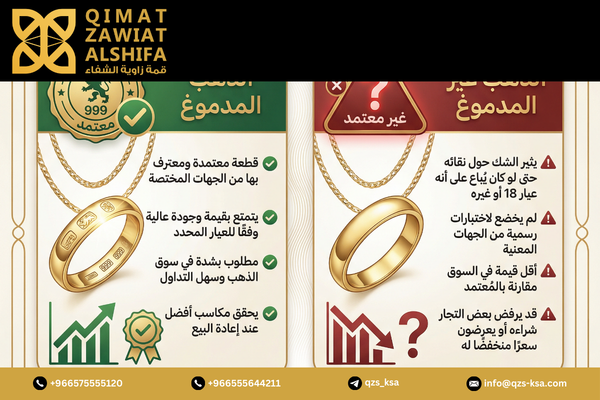
In conclusion, hallmarks and stamps on gold represent your true gateway to safe investment and informed purchasing. Understanding the different types of hallmarks and stamps on gold not only allows you to distinguish between genuine and counterfeit gold, but also helps you confidently and professionally assess the true value of each piece.
Whether you're looking for everyday jewelry to add a touch of elegance to your look, or gold bars for a long-term investment, making sure of the official hallmark and the correct carat is your first step towards assured quality and sustainable value in the market.
Don't make a purchase decision randomly. Start today by examining your current gold pieces, making sure of their hallmarks, and always be a smart investor who knows the value of what he owns.
