
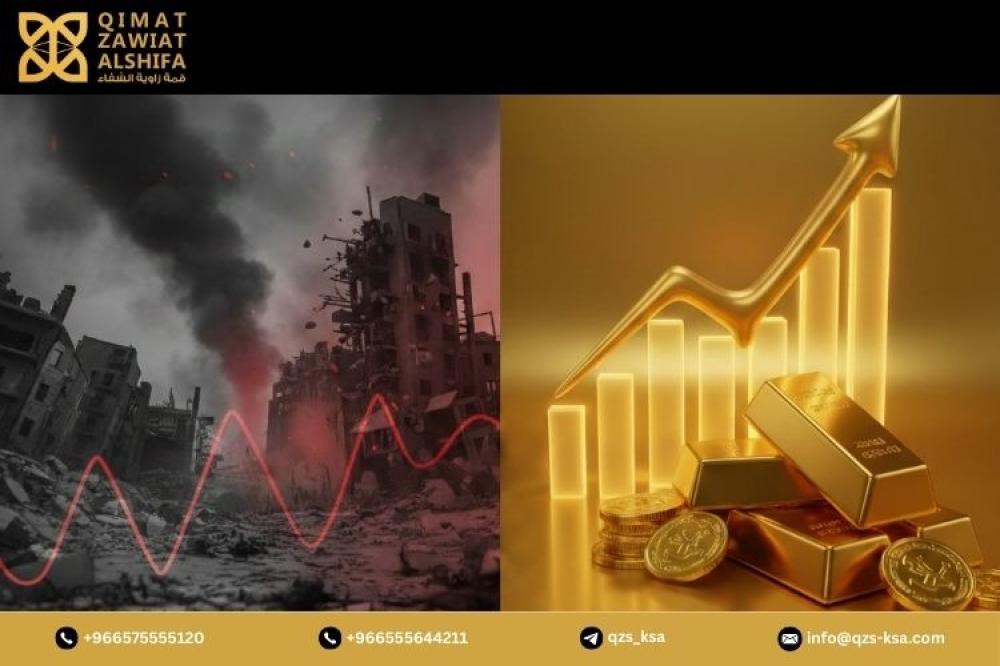
Gold is one of the most sensitive assets to global events, reacting directly to political and economic changes, especially during times of war, crises, and fluctuations in monetary policy. Throughout history, gold has consistently been the first choice for investors when confidence in traditional currencies and markets falters, earning it the reputation of a "safe haven."
Recent experiences show that global events, primarily wars, geopolitical tensions, and central bank decisions, are the main drivers of gold price fluctuations , whether upward or downward.
In this article, published by Qimmat Zawiyat Al Shifa Store , we highlight the real impact of global events, especially wars and monetary and economic policies, on gold price movements, and explain the reasons that make this precious metal the center of the global financial scene during times of crisis.
Why is the price of gold affected by global events?
Gold is not just a precious metal; it's a global investment asset independent of the performance of governments and corporations. Therefore, when global turmoil occurs, investor behavior shifts, and capital moves from high-risk assets like stocks to gold.
The power of gold lies in the fact that:
- A store of value over time.
- A hedge against inflation.
- Originally not directly linked to a single currency or economy.
Thus, gold remains the ideal choice for investors seeking financial security and stability in times of uncertainty. If you want to know the best time to buy gold
Or you can check out gold price forecasts in Saudi Arabia ; these sources provide accurate analyses that help you make the right decision.
The impact of wars and geopolitical tensions on the price of gold
The geopolitical drivers of gold prices are not limited to major global conflicts; even limited regional tensions can have a significant impact on the market. Political crises in sensitive regions, ongoing trade disputes between major economic powers, or even instability in strategic waterways can all trigger investor anxiety.
As these concerns escalate, gold quickly returns to the forefront of investment options, as if the market is anticipating events and reacting to potential risks before they actually materialize. In this context, central banks play a crucial role, as they may adjust their gold reserves in response to these indicators, which in turn impacts global price movements.
Among the most prominent regional factors affecting the gold market are:
- Political tensions and instability in the Middle East, given the region's direct impact on the global economy
- Trade disputes and the imposition of tariffs between major economies create an environment of uncertainty.
- Local crises in resource-rich countries, which may indirectly affect global markets
This effect was clearly demonstrated at the beginning of 2026, when the price of gold reached record levels exceeding $4,900 per ounce, driven by a wave of simultaneous geopolitical turmoil. This clearly reflects the role of gold as a sensitive indicator of the state of tension and instability in the world . The impact of the US interest rate on gold can be viewed for more details on the relationship between interest and gold prices.
The impact of monetary and economic policies on gold prices
The movement of gold prices is not limited to geopolitical events alone, but monetary and economic policies play a pivotal role in determining its course, as central bank decisions, inflation levels and trade policies directly affect the attractiveness of gold compared to other investment assets.
1. Inflation and expansionary monetary policies
When countries pursue expansionary monetary policies, such as quantitative easing and increasing the money supply, inflation fears rise. In this climate, investors turn to gold to protect their wealth from erosion of its value, which leads to a rise in its price.
2. Trade policies and tariffs
Trade policies and tariffs between major economic powers are disrupting global markets and increasing uncertainty. Trade disputes and tariffs imposed during periods such as 2024 have contributed to rising gold prices as investors seek safe-haven assets.
3. Central bank gold purchases
Recent years have seen a significant increase in central bank gold purchases as part of strategies to diversify monetary reserves and reduce reliance on foreign currencies. This trend has contributed to supporting gold prices and pushing them to record highs, with the price per ounce recently exceeding $4,000 for extended periods.
Why does gold remain a safe option despite volatility and wars?
Although the price of gold fluctuates in the short term, in the long term it maintains its purchasing power, and for this reason:
- Central banks hold it
- It is used as a hedging tool in investment portfolios.
- Demand for it increases during times of crisis.
conclusion
The impact of global events on the price of gold is not random, but rather a natural consequence of gold's role as a safe haven during times of fear and uncertainty. Wars, political tensions, and monetary policies are all key factors that determine the upward or downward direction of gold prices.
As the world continues to face recurring political and economic crises, gold will remain a key element in the global economic landscape, reflecting investors' concerns and expectations for the future of the markets.
Frequently asked questions about how geopolitical events affect the price of gold?
When does the price of gold stabilize during times of crisis?
Although gold typically benefits from crises, its price may decline or stabilize in certain situations, such as when global economic conditions improve, political tensions subside, interest rates rise sharply and consistently, and inflation stabilizes. In these circumstances, investors tend to return to higher-yielding assets, thus reducing demand for gold.
Does the price of gold rise during wars?
Gold often experiences a significant rise during periods of war and geopolitical shocks, as investors increasingly turn to it as a safe haven that helps preserve capital amid the sharp fluctuations affecting stock and currency markets.
Why does the price of gold jump during wartime?
The rise in gold prices during wars is attributed to several key factors, most notably escalating political tensions that create uncertainty in global markets, thus reinforcing gold's status as a safe-haven asset. Central bank policies, such as interest rate cuts or massive liquidity injections, also contribute to currency weakness and rising inflation, prompting investors to turn to gold as a hedge.
Is it advisable to buy gold at the present time?
The answer to this question depends on the investment objective. Gold is a suitable option for preserving value in the medium to long term, especially given the continued demand for it as a safe haven and the increased purchases by central banks. In the short term, however, speculation may involve risks due to prices reaching record highs, despite recent limited declines.
